


Keyword: BIX-CK818 thoracic drainage manikin chest drain trainer closed drainage model water seal bottle trai
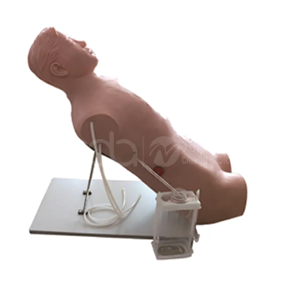
Short answer: BIX-CK818 is an adult upper-body trainer for closed thoracic drainage. The page specifies a recumbent electronic patient with spontaneous chest and abdominal breathing, palpable clavicle, sternum and rib gaps, four bilateral insertion sites, and a sealed bottle whose liquid level rises and falls with each breath. It trains tube placement and post-operative drainage nursing — it does not simulate a diseased lung, bleeding, or a failed drain.
Key takeaways
| Item | Published detail |
|---|---|
| Model | BIX-CK818 |
| Category | Clinical Medicine Models → Adult Puncture Procedures |
| Form | Adult upper body in slope decubitus position |
| Breathing | Mechanical device: spontaneous breathing with chest and abdominal movement |
| Insertion sites | Bilateral midclavicular intercostal space; bilateral anterior axillary line at the fifth rib |
| Drainage feedback | Water level in the sealed bottle moves up and down with respiration |
| Package size / weight | 43 x 25 x 25 cm / 4.5 kg |
| Price | Not published — quotation required |
A closed drainage system works because the tube ends under water. Air and fluid leave the pleural space, but air cannot travel back up the tube, so the lung can re-expand. The moving water level is the visible proof: it swings with intrathoracic pressure during breathing and stops swinging when the system is blocked, kinked or disconnected.
That is exactly what BIX-CK818 puts in front of a trainee. The page states that the liquid level in the sealed bottle fluctuates up and down with respiration. A student who has watched that swing, and then watched it stop when a clamp is applied, understands the nursing check faster than a student who has only read the sentence.
| Published feature | What it lets you teach |
|---|---|
| Slope decubitus position with soft, realistic texture | Patient positioning, draping and the arm-up posture used for lateral chest access. |
| Palpable clavicle, sternum and intercostal gaps | Landmark identification before incision — the step that decides whether a tube enters the pleural space. |
| Four bilateral insertion sites | Safe triangle practice and the difference between midclavicular and axillary approaches. |
| Spontaneous chest and abdominal breathing | Timing the insertion with respiration, and observing chest movement after the tube is in. |
| Water-seal bottle with moving liquid level | Reading a drainage system: swing, bubbling, and the absence of both. |
| Post-operative drainage tube nursing | Securing the tube, checking patency, documenting output and repositioning the patient. |
Pleural procedures are taught badly when they are taught once. A 2026 review of contemporary pleural drainage in adult practice sets out image-guided techniques, procedural safety and training standards in the same document, which reflects how closely technique and supervision are now linked [1]. A 2026 study of tube thoracostomy across emergency medicine, thoracic surgery and intensive care residents found performance differences between specialties — evidence that the procedure needs a shared, explicit standard rather than an apprenticeship [2]. A scoping review of procedural skills decay in emergency medicine adds the missing piece: skills that are not rehearsed degrade, which is the argument for a manikin that can be used every month rather than a cadaver session once a year [3].
| Not stated on the page | Why it matters before ordering |
|---|---|
| Skin and chest-wall material | Determines cleaning routine, puncture-site wear and how many insertions a site tolerates. |
| Replacement skin or insert availability | The insertion site is the consumable; a multi-year plan needs the part numbers. |
| Bottle volume and tubing diameter | Affects whether standard ward tubing and a chest drain bottle can be used in class. |
| Power requirement for the breathing unit | Decides where the station can be placed. |
| Price at your quantity and lead time | Quotation item; ask for the spare-parts list in the same email. |
Write to bomn@adabomn.com with the model number BIX-CK818 and your annual cohort size, and we will send the material, spare-part and carton data in one reply.
Q1. What does BIX-CK818 simulate?
An adult upper body in a slope decubitus position with spontaneous breathing, palpable rib landmarks, four bilateral tube-insertion sites and a sealed drainage bottle whose liquid level moves with respiration.
Q2. Does it show a pneumothorax or bleeding?
No. The product page describes drainage placement and post-operative tube nursing only. Complications such as bleeding, blockage or dislodgement are not listed as simulated scenarios.
Q3. How many insertion sites are there?
Four, described as bilateral midclavicular intercostal spaces and bilateral anterior axillary line at the fifth rib.
Q4. Can trainees see that the drain is working?
Yes. The liquid level in the sealed bottle is described as fluctuating up and down with the patient's breathing, which is the visible sign of a patent, sealed system.
Q5. What is the shipping weight?
4.5 kg, with a package size of 43 x 25 x 25 cm.
Q6. How do I request a quotation?
Email bomn@adabomn.com with the model (BIX-CK818), quantity and cohort size. Ask for the replacement-skin part number and the tubing specification at the same time.
Write to bomn@adabomn.com for the BIX-CK818 specification sheet and a quotation. If you are building a puncture and drainage room, mention that you also need thoracentesis, pericardiocentesis and lumbar puncture trainers, so the landmark conventions and consumables are consistent across the set.