


Keyword: bleeding arm training model hemorrhage control trainer tourniquet training arm amputation wound mode
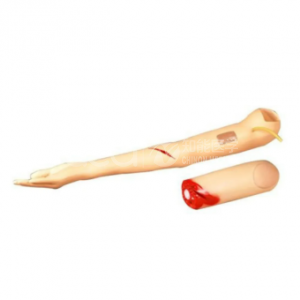
Short answer: BIX/G105-2 is an arm-only haemorrhage control trainer with two interchangeable trauma modules — a traumatic arm wound and an above-arm amputation. The adabomn page states that the arm can be filled with simulated blood and pressurised to mimic arterial flow, and that trainees practise haemostasis, bandaging on the bleeding wound, bandaging of the amputated limb, and deltoid intramuscular injection. No price, carton size or weight is published.
Key takeaways
| Item | Published detail |
|---|---|
| Model | BIX/G105-2 |
| Product name on page | Controlled Bleeding Arm Model |
| Body format | Single arm |
| Trauma modules | 2 — arm amputation, traumatic arm wound |
| Bleeding simulation | Fillable with simulated blood; arterial pressure can be simulated |
| Listed procedures | Haemostasis, bandaging, amputated-limb bandaging, deltoid IM injection |
| Price | Not published — quotation required |
| Carton quantity / size / weight | Not published |
| Module | Technique it supports | What cannot be assessed on it |
|---|---|---|
| Traumatic arm wound | Direct pressure, wound packing, pressure dressing, dressing security under movement. | Junctional bleeding; pelvic or abdominal packing. |
| Arm amputation | Tourniquet selection, placement height, tightening until bleeding stops, time recording. | Two-bone forearm versus single-bone arm differences; leg tourniquet placement. |
| Pressurised blood circuit | Recognising arterial versus venous flow, checking a dressing under pressure. | Actual blood loss volume measurement. |
| Deltoid site | Landmarking the acromion, injection angle, site rotation. | Vastus lateralis or ventrogluteal sites. |
Haemorrhage control is one of the few skills where the failure mode is invisible on a dry manikin. A tourniquet that is placed correctly but not tightened enough looks identical to one that works — until blood keeps flowing. The published literature is blunt about this gap: a review of haemorrhage-control training in medical education found wide variation in what programmes teach and how competence is verified [1], and an evaluation of Stop the Bleed courses concluded that the format is effective but still needs improvement in retention and assessment [2].
The strongest evidence for equipment choice comes from course-level comparisons rather than product claims. A European study of layperson Stop the Bleed courses measured knowledge and skill gains before and after training and found that hands-on practice with a bleeding simulator was the component associated with correct tourniquet application [3]. That is the argument for a pressurised arm: it makes the tightening step observable, so an instructor can fail a trainee who stops too early.
| Minute | Task | Pass criterion |
|---|---|---|
| 0–5 | Scene safety, gloves, direct pressure with both hands. | Pressure applied before any equipment is opened. |
| 5–12 | Pack the traumatic wound, apply pressure dressing. | Bleeding stops with dressing in place; dressing does not shift when the arm is moved. |
| 12–20 | Swap to the amputation module; apply tourniquet. | Tourniquet 5–7 cm above the stump, tightened until flow stops, time written down. |
| 20–25 | Deltoid injection on the same arm. | Correct landmark, correct angle, site recorded. |
| 25–30 | Debrief against the recorded time and the residual bleeding. | Trainee can state why the tourniquet was needed and when to convert. |
Ask sophia@adahealthy.com for the replacement-module price list before you plan the station: the two trauma modules are the parts that wear out.
Q1. What is BIX/G105-2?
A single-arm controlled bleeding trainer with an amputation module and a traumatic-wound module, used for haemostasis, bandaging and deltoid injection practice.
Q2. Does it bleed on its own?
No. The page states the arm can be filled with simulated blood and that arterial pressure can be simulated — the pressure source is part of the setup, not automatic.
Q3. Can it be used for leg tourniquet training?
No. It is an arm model; leg and junctional tourniquet techniques require a different trainer.
Q4. Is a price published?
No. The page carries no unit price; BIX/G105-2 is a quotation item.
Q5. What are the shipping figures?
Not published. Carton quantity, package size and gross weight are absent from the page.
Q6. How do I request a quotation?
Email sophia@adahealthy.com with model BIX/G105-2, your quantity, the modules you need as spares, and your delivery city.
Write to sophia@adahealthy.com for the BIX/G105-2 specification sheet, the spare-module list and a landed-cost quotation. If your programme also teaches junctional bleeding, say so — a single-arm trainer will not cover it.