


Keyword: Sengstaken-Blakemore tube training three lumen two balloon tube variceal bleeding simulation BIX-
Balloon tamponade is a bridge, not a destination: it buys time for definitive therapy in massive or refractory oesophageal variceal bleeding, and it fails when the team has never rehearsed the inflation sequence together [1]. The BIX-LV15 is built for exactly that rehearsal — a full-body adult male trainer whose three-lumen two-balloon tube can produce a simulated gastric variceal bleed that stops when the technique is correct.
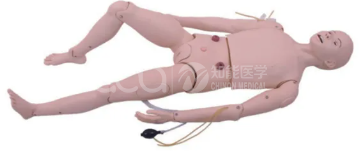
| Item | Detail |
|---|---|
| Model | BIX-LV15 |
| Body | Adult male, full body, marked anatomical landmarks, flexible joints |
| Material | Imported thermoplastic mixed rubber (skin-feel surface, non-toxic) |
| Core skill | Three-lumen two-balloon (Sengstaken-Blakemore type) compression and haemostasis |
| Secondary skills | Nasogastric feeding, gastric lavage, pupils, carotid pulse, catheterisation, IV injection |
| Bleed simulation | Simulated gastric variceal bleeding stops when compression is performed correctly |
| Genitalia | Interchangeable male and female inserts with simulated urine output |
| Typical buyers | Nursing colleges, ICU and emergency skills labs, gastroenterology training units |
Because the failure modes are physical. Tube migration, over-inflation, unrecognised oesophageal balloon inflation before gastric positioning, and aspiration during insertion are all hand skills that degrade without repetition. Simulation with deliberate practice outperforms traditional clinical teaching for procedural skill acquisition [2], and the tamponade literature is blunt about the consequence of poor technique: rebleeding and serious complications are common enough that guidelines position balloon tamponade strictly as a temporising bridge [1].
The BIX-LV15 gives you a repeatable loop: insert, inflate, verify, traction, reassess. The model's bleed stops when compression is right, so the trainee gets feedback from the patient rather than from an instructor's opinion.
Phase 1 — Prepare and verify (5 minutes). Trainees test both balloons with a syringe before insertion, check for leaks, and confirm the tube is labelled at the 45 cm mark. In the model, this is also where you assign roles: operator, assistant holding suction, airway monitor, and timekeeper.
Phase 2 — Insert and position (10 minutes). Insert to the measured depth, aspirate to confirm gastric placement, then inflate the gastric balloon with the specified volume while listening for the model's bleed to change. The BIX-LV15's landmarks make this reproducible: trainees can palpate the manubrium and xiphoid, and its flexible joints allow the semi-upright positioning used in practice.
Phase 3 — Traction and oesophageal balloon (10 minutes). Apply traction, secure the tube, then — only if bleeding continues — inflate the oesophageal balloon to the pressure specified by your protocol. This is the phase where teams most often skip the position check. Build a hard stop into your checklist: no oesophageal inflation without a confirmed gastric position.
Phase 4 — Debrief with the model still in place (10 minutes). Ask each trainee to state the maximum duration of tamponade in your protocol, the signs of aspiration, and the escalation pathway. Then run the same scenario again in under 24 hours; the second run is where learning consolidates.
The BIX-LV15 is not a single-skill manikin, which matters for nursing curricula that cannot justify a single-purpose purchase:
Q1. Is the BIX-LV15 a full-body or partial-body trainer?
Full body: an adult male torso and limbs with marked anatomical landmarks, flexible joints and a simulated skin surface, so positioning and traction can be practised realistically.
Q2. Does it simulate bleeding that responds to compression?
Yes. The listing states the three-lumen two-balloon compression simulates gastric variceal bleeding and that effective haemostasis is achieved when the technique is performed correctly.
Q3. Can it be used for non-emergency nursing skills too?
Yes — nasogastric feeding, gastric lavage, pupil assessment, carotid pulse, catheterisation and intravenous injection are all supported, which is why nursing colleges often buy it as a shared skills asset.
Q4. What is the typical order quantity?
Most programmes start with one or two units per skills lab and add a second unit once the drill is embedded in the curriculum. Ask for the carton size and gross weight to plan storage.
Q5. How long does a full drill take?
Plan 35–40 minutes per run including set-up and debrief, and schedule a repeat within 24 hours. Two runs per trainee is the minimum for skill retention.
Q6. Can we get a demonstration before ordering?
Ask for a video of the inflation sequence and a reference site in your region. Email bomn@adabomn.com with your cohort size and destination port to arrange it.
For the specification sheet, tube compatibility list and a landed-cost quotation: bomn@adabomn.com. Production follows ISO 45001 management practice; CE documentation is available for EU procurement.