


Keyword: BIX-BLS800-2 multifunctional emergency nursing simulator AED training manikin tracheal intubation
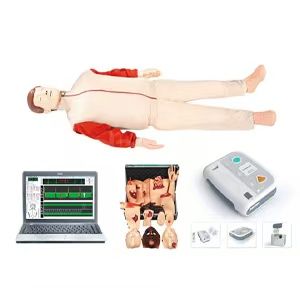
Most emergency training fails at the handover, not at the skill. A nurse can intubate well, defibrillate well and still lose the patient because nobody owned the sequence. The BIX-BLS800-2 is built for exactly that gap: it is a full-body emergency nursing simulator that carries AED training and tracheal intubation functions on the same manikin, so a team can rehearse one continuous resuscitation instead of three separate skills.
This guide sets out a drill design that uses the manikin's combined functions, and the checks a training department should make before ordering.
| Capability | What it supports in a drill | Training value |
|---|---|---|
| AED function | Rhythm recognition, pad placement, shock delivery sequence | Trains the pause-and-clear routine under time pressure |
| Tracheal intubation | Airway positioning, laryngoscope handling, tube placement | Lets airway and chest skills run on one casualty |
| Full-body nursing care | Positioning, suction, monitoring, drug administration | Keeps nursing actions inside the scenario instead of off-stage |
| Team interaction | Role rotation at one manikin | Exposes handover and leadership gaps |
A single-body platform matters more than the feature list. When airway, electrical therapy and nursing care happen on the same manikin, the instructor can score the transition between them — the ten seconds where compressions stop, the airway is taken, and the defibrillator is charged. That transition is where real resuscitation time is lost [1].
Deliberate practice with immediate repetition is the instructional feature most consistently associated with skill retention in simulation-based education [2]. A drill that ends at the debrief without a second run leaves most of the learning unused.
The BLS800-2 is a nursing and emergency-response trainer, not a high-fidelity physiological simulator. It will not generate variable lung compliance, spontaneous rhythms or drug pharmacokinetics. If a department's objective is team-based crisis management with a responsive physiology, this class of manikin will disappoint, and a screen-based or high-fidelity platform is the correct buy.
The honest use case is volume training: many learners, repeated short scenarios, one durable body. That is also the case where a combined AED and intubation platform pays for itself, because it replaces two single-purpose manikins in the store room.
Specification and quotation. Current pricing, carton details and lead time for the BIX-BLS800-2 are available from bomn@adabomn.com.
Q1. What skills can be practised on the BIX-BLS800-2? AED operation, tracheal intubation, and general emergency nursing care including positioning, suction and monitoring, all on one full-body manikin.
Q2. Is it suitable for nursing schools rather than hospitals? Yes. It is designed for volume training with many learners and repeated short scenarios, which is the typical nursing-school pattern.
Q3. Does it simulate spontaneous breathing or pulses? The platform is a skill trainer with AED and airway functions. Departments needing responsive physiology should specify a high-fidelity simulator instead.
Q4. How many learners can one manikin serve? A workable ratio is one manikin per drill team of three to four, rotating roles so every learner takes the airway and the defibrillator at least once.
Q5. Can it be used for CPR compression feedback? The unit is specified for AED and intubation functions. Ask the supplier to confirm whether compression feedback is included before you plan compression-quality scoring around it.
Q6. What should we order with the manikin? Airlines, tubes, a training AED interface, face-skin spares and a carrying solution. Ask bomn@adabomn.com for the consumables list that matches your course.
Product page: How to Run a Multi-Skill Emergency Drill on the BIX-BLS800-2 Simulator — specification, packing data and a quotation request form.
For a quotation on the BIX-BLS800-2 with the AED interface and intubation consumables, write to bomn@adabomn.com with your class size and the skills your course assesses.